In honor of Petrus Comestor aka Pierre le Manger who I learned via Wikipedia was called that because he was a devourer of books (considered a good thing in his day) and is supposed to have composed his own epitaph:
"Petrus eram ... dictusque comestor, nunc comedor."
("Peter was I... and called the devourer: now I am eaten.")
Though maybe it's not an honor. I'm trying to at least record the names of things I've been reading as they flash past my eyes. Excuse: I read as part of my job. So the flash is almost stroboscopic. And things are begun and then left to ripen or simmer while I jump to other things, like a short order cook, so it's even more disorderly than it may appear.
Beached on the couch with pins in my toes to correct a foot problem and unable to do anything but read and be over-medicated, it seemed like this was a good time to look at what's around me. To my right, in a pile of notebooks, pillows, medicine bottles, two novels: Thirkell, Angela. 1951. The duke's daughter and Happy return. Not sure what to say about these as they go way beyond guilty pleasure to something deserving the literary death penalty. No, not the literary one because they're very funny and engaging, something like her literary ancestor Trollope (she sets this in Barsetshire) but they're so reactionary in their attitudes I can't believe I'm reading them right along and not burning them in a pile out in the street while I rant to the skies about the horrible attitudes toward...toward everything. It's about an imaginary place where the aristocrats deserve their places and fill them admirably, but are also eccentric and amusing, crusty but good-hearted, where the "lower orders" recognize the natural authority of their betters and would be lost without them, where nothing really bad ever happens to anyone except hurt feelings and shows of bad manners or bad taste and the misunderstandings in romance or avocation that all get more or less worked out. Not something I would brag about reading but if you're stuck needing distraction while you get through a bout of tedious painfulness they seem perfect (since I've read and reread all the so-called Golden Age stuff, which offers something like that dream world). Later addition: I've just learned she was a granddaughter of Edward Burne-Jones the Pre-Raphaelite painter. Now it makes sense. http://angelathirkell.org/atbio.htm

Then Burnshaw, Stanley. 1981. The Poem itself. New York: Horizon Press. This recommendation for something to read on the difficulties of translation came out of reading William Gass' book on translating, or rather not ever succeeding in translating, Rilke, and what the difficulties are: Reading Rilke. This morning Burnshaw was teaching me about the beauties and intricacies of Baudelaire's L'Invitation au Voyage to a dreamworld where there is nothing but "ordre et beauté,/Luxe, calme et volupté." So places that don't exist may be a developing theme. And my couch on a quiet early Saturday morning in this river town listening to the birds get started, drinking a first cup of coffee, making notes on the way this old French poet made his music, without anything pressing to do or worry about, is a dreamworld in its way.
At the bottom of that pile: Hodder, Ian. 2012. Entangled: an archaeology of the relationships between humans and things. Malden, MA: Wiley-Blackwell. I haven't gotten far enough into it to say what's going on yet but something interesting is happening. I have been interested lately in catching up with Bruno Latour's thinking and he's mentioned here. There seems to be a phenomenological bent. One thing that caught my attention was the author's remark that, despite a renewed interest in things, with mention of someone doing "thing theory," there is still too much stress on what things mean to humans and not enough attention to things as they are in themselves. But not sure who is going to be discussing them if not humans. But what I really found intriguing is the sense of mixture between us and objects, as when he refers to anthropological discussion of "souls mixed with things" (Mauss) and "distributed personhood"(Strathern). This may sound more like words than things but it does give some idea of how one thing leads to another around here. Re my addiction to reading, which has something in it like a dog's addition to following scents.
Speaking of words, I've been watching and listening to Marilynne Robinson, someone whose work I find very inspiring and strengthening, if that doesn't sound too absurd and Victorian. She was talking to someone--it might have been the interview with Bill Moyers or the reading at Columbia--and in answer to a question she said, "intelligence is a cold word," and then added, "well, they're all cold words." From someone else, that might have sounded affected. But from her, since she does so much to make sure hers are not cold, it just sounded like a worker's comment on an especially tricky aspect of the job.

Starting at the top: Merleau-Ponty, Maurice, trans. Colin Smith. 2014. Phenomenology of Perception. Then Mishra, Pankaj. 2012. From the ruins of empire: the intellectuals who remade Asia. Then more philosophy: Taylor, Charles. 1997. Philosophical arguments. Cambridge, Mass: Harvard University Press. Then poems: Fisher, Roy, intro. by August Kleinzahler. Selected Poems. Chicago: Flood Editions, 2011. And Meehan, Paula. 2009. Painting rain. Winston-Salem, NC: Wake Forest University Press. At the base of all that, a meditation: Maitland, Sara. 2009. A book of silence. Berkeley, Calif: Counterpoint. Yes, they look suspiciously like bibliography presented this way because they are in a way. I finally decided to get organized and began using EndNote for the things I write at work which require references. To make sure I learned it, I forced myself to do a bunch of tedious data entry just to get the moves memorized, and to make that useful, I decided I should enter every book that came into the house, even if I did no more than that. In more ambitious moments I've told myself to make some notes on each of them. But that would be like telling the dog with his nose to the ground hurrying along to stop and note each scent and explain which gave him a lead and which were just of interest in themselves and which turned out to be stinkers though promising at first. But that might be something I could only end up doing if I can manage to get into one of those dreamworlds.
Why this curious pile? The Taylor essay against epsitemology reminded me of something I'd abandoned in disgust in the mid-1980s when I left my tenure track academic job and sold or gave away all my philosophy and post-modern theory. Even though that had all been a false trail--or maybe the way I took it on was the false trail -- there was a pleasure in tangling with the difficulty and seriousness of it that it turned out I missed.
I found after a few struggles that I could read that kind of thing again the way I used to and Taylor's discussion (like Rorty's, which I'd looked at a few weeks earlier) reawoke (or tore open or snapped the top off, whatever analogy works here) my old attraction to Heidegger, which persisted as an interest even taking into account his disgusting politics (usually enough to kill that off).
So when I found Merleau-Ponty at the used bookstore barely marked at all, I had to bring it home. Mishra may be there because of something by him read in the London Review of Books or it might be I realized I need to know more about his subject while I was reading Empire of Cotton (Beckert, Sven. 2014. Empire of cotton: a global history).
Mishra's book flips things for me, as a kid who grew up in the 50's, because here's a history that starts with the Japanese defeat of the Russians in the 1905 war (something that might have been touched on very lightly in our history books if at all) but, as he shows, it was a tremendous event that was hailed across the Middle East and Asia. And Beckert's account of how the cotton economy took what it wanted, did what it wanted and stifled all its competitors, makes it clear why those countries would be cheering that as a victory.
The Beckert I came to from work, while critiquing an article on sustainability that looked at our relationship to the environment in terms of "capital." There are lots of reasonable aspects to seeing it that way---i.e. trying to find an equivalent for economic value -- but also some big problems and one of them, it seemed to me, was in something like the connection between slavery and cotton (social and environmental and economic systems interlocking or so it seemed). So it seemed outrageous to talk quietly and calmly about environmental capital without thinking about what goes on with labor, especially the labor in what's called agricultural and extractive, where it involves raw materials and happens far from witnesses. But I know very little about it. This was just an intuition that there was something more to it.
The Fisher book has been on my list for a while. Just because. Not sure why. Maybe just because it's too easy for me to fall under the sway of some admired writer (later work of Charles Wright, say) or to go along in grooves and habits in my own stuff I no longer even notice so that if I hear of something that might be "good for you" I tend to keep an eye on it and get to it eventually. Is it? Don't know yet. Not a question of liking or disliking I'm after but something else. I'm not as automatically in favor of experiment as I was so I'm a bit wary. Paula Meehan's book was recommended by the poet April Fallon and seemed likely to be good also because I notice my growing up Catholic seems to makes Irish writing come out of a familiar world. Not that all Irish writers are Catholic or that I am anymore myself but there's some kind of shared experience there. I'm glad to have read it. For one thing, it looks like she came out of a world of experience not many poets know first hand. It made her tough and unsentimental but not in the corny ways a male poet might show those qualities. In another life she might have written bluegrass songs like Carter Stanley. But she's obviously deeply read and understands the way the old Chinese poets could say it without saying it to death and sometimes without you even knowing they'd said it at all which to me is a wonderful thing. I especially liked this one below which is a section of a longer piece called Six Sycamores that looks around a group of houses on a city street:
Number Fifty-One
And as the ages pass, the solid world longs
for its own dissolution: those red bricks
dream of the clay pit; with every lick
of the north wind rough fender remembers the song
of the river grinding it down; granite quoins desire
their home in the mountains--above Ballyknockan, the wild
bird's lonely tune, the shadow on the lake;
the iron railings guard the memory of fire,
of ore-selves before being smelted and cast and exiled
to these unforgiving streets; the shutters ache
for the woods, the green light, the sap strong
in bole, in branch, the undergrowth quick
with life; linen drapes must crave someone to unpick,
to unspin, to be bluest flax blossom all summer long.
I like the way she gets it all flowing backwards.
There are more items to enter from the chaos (with some kind of odd logic or linkage) around me but maybe that's enough for now. To be continued.


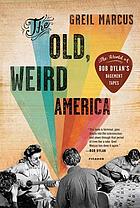 Marcus, Greil. The Old, Weird America: The World of Bob Dylan's Basement Tapes. New York: Picador, 2011. Print.

